Note: This post contains affiliate links. If you make a purchase through them, I may earn a small commission at no extra cost to you. This helps me maintain the site and continue providing “inside perspective” on Japanese culture. Thank you for your support!
Introduction
If you’ve ever watched Japanese anime or visited Japan, you’ve probably heard the phrase “itadakimasu” before eating.
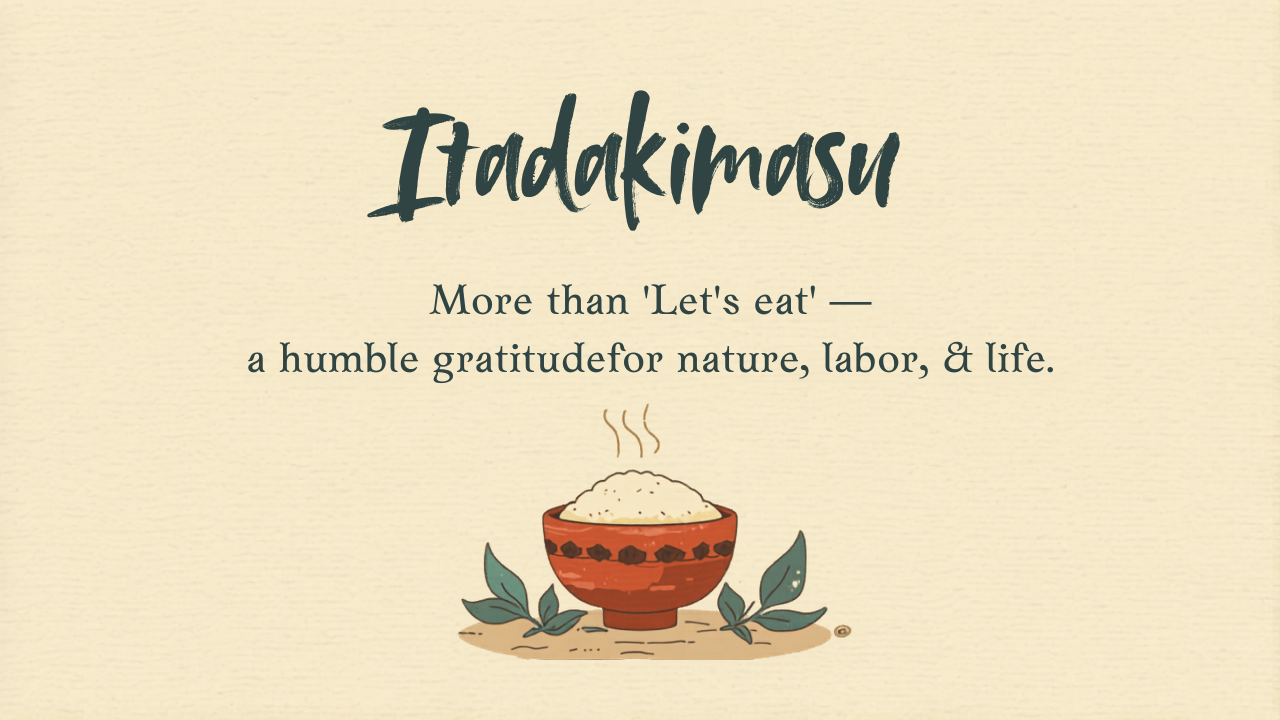
It’s often translated as “let’s eat,” but that’s not quite accurate.
In reality, itadakimasu carries a much deeper meaning rooted in Japanese culture.
The Common Misunderstanding
Many English resources translate itadakimasu as “let’s eat.”
While this translation works in context, it misses the cultural nuance behind the word.
Unlike “let’s eat,” itadakimasu is not simply an invitation to start a meal.
The Real Meaning of “Itadakimasu”
The word itadakimasu comes from a humble form of the verb meaning “to receive.”
In this context, it expresses gratitude for everything involved in the meal:
- The animals and plants that gave their lives
- The people who prepared the food
- The effort it took to bring the meal to the table
It reflects a mindset of humility and appreciation.
Interestingly, even people who don’t say it out loud may still feel a sense of gratitude before eating.
Is “Itadakimasu” Religious?
Some people assume that itadakimasu has religious meaning.
While it is influenced by ideas found in Buddhism and traditional Japanese beliefs, most people today do not consciously associate it with religion.
Instead, it is understood more as a cultural expression of gratitude.
When Do Japanese People Use It?
Itadakimasu is said:
- Before eating
- Whether alone or with others
- At home, in restaurants, and in school settings
For many Japanese people, saying it is simply a natural habit.
How It’s Actually Used (Real-Life Perspective)
In reality, whether people say itadakimasu at home varies.
Some families treat it as an important habit, while others may forget or not emphasize it as much.
However, in structured environments like kindergartens and elementary schools, it is almost always said together as part of daily routines.
On the other hand, in business situations or large social gatherings, it is often replaced by expressions such as a toast.
That said, this does not mean that saying itadakimasu is inappropriate—many people still say it quietly to themselves before eating.
Many Japanese people don’t consciously think about all of this every time they say itadakimasu.
For most, it’s simply a habit they’ve had since childhood.
However, that habit itself reflects how gratitude is embedded in daily life in Japan.
How to Explain It in English
Since there is no perfect English equivalent, it’s better to explain the meaning rather than translate it directly.
For example:
- “A phrase said before eating to express gratitude”
- “A cultural expression of appreciation for food”
Trying to force a direct translation often leads to misunderstanding.
Conclusion
Itadakimasu is a great example of how language reflects culture.
It’s not just about eating—it’s about gratitude, respect, and awareness of what goes into a meal.
Understanding itadakimasu is not just about learning a word—it’s about understanding how gratitude is naturally built into everyday life in Japan.
This is what makes it difficult to translate, but meaningful to understand.
If you want to understand what Japanese people say after eating, check this:
コメントを残す